MRCEM Primary tests the basic sciences that underpin emergency medicine. Passing it is less about last-minute cramming and more about steady, blueprint-focused preparation over a few months. If you study the right things in the right order and practise enough questions, it is a very passable exam. Here is a strategy that works for busy clinicians juggling revision around a full rota.
Start With the Blueprint
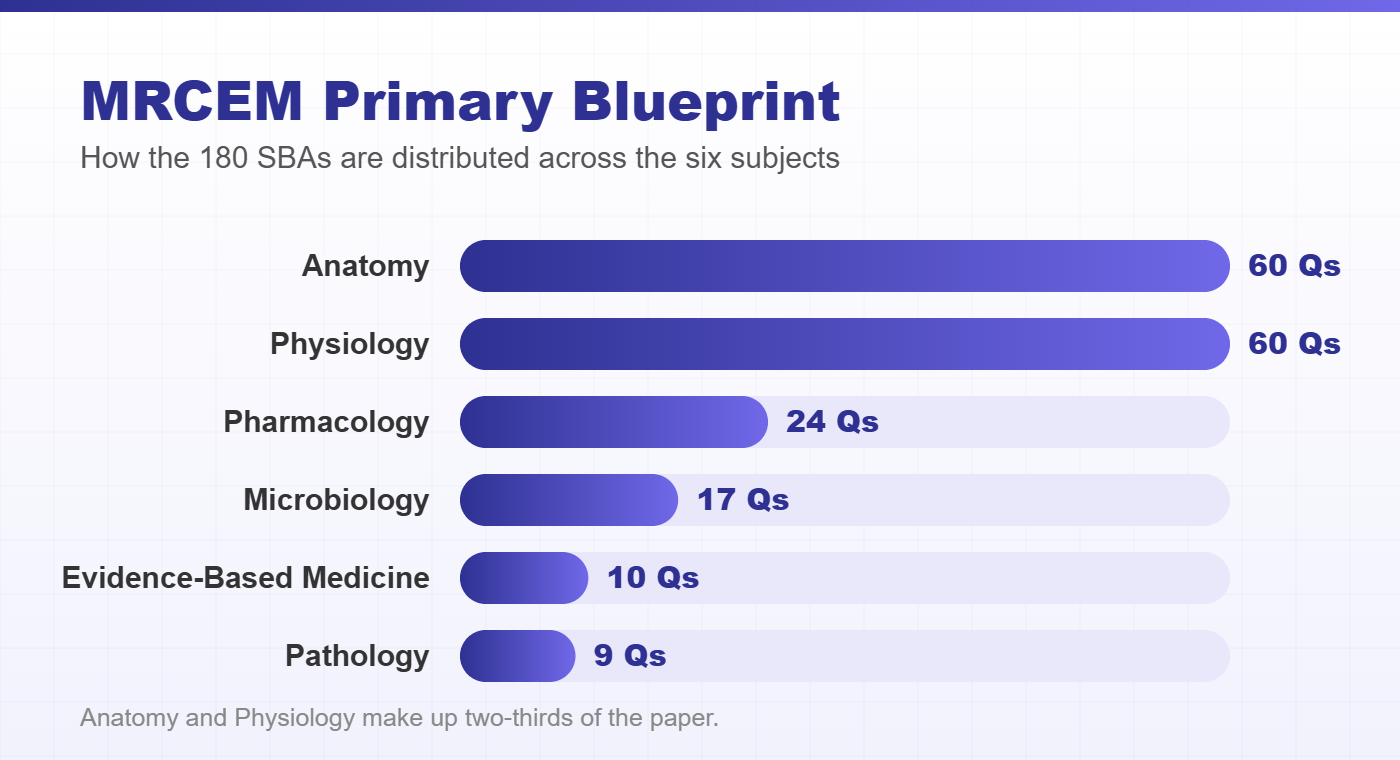
The most common mistake candidates make is studying everything equally. The exam does not. The 180 questions are weighted across six subjects, and that weighting should drive how you spend your time. Anatomy and Physiology together make up around two-thirds of the paper, so they deserve the lion’s share of your revision. Pharmacology is the next biggest block, followed by Microbiology, with Pathology and Evidence-Based Medicine carrying fewer marks. That does not mean you can ignore the smaller subjects — they are where easy, well-defined marks are often won or lost — but it does mean your timetable should mirror the blueprint rather than your personal comfort zone.
Build a Realistic Schedule
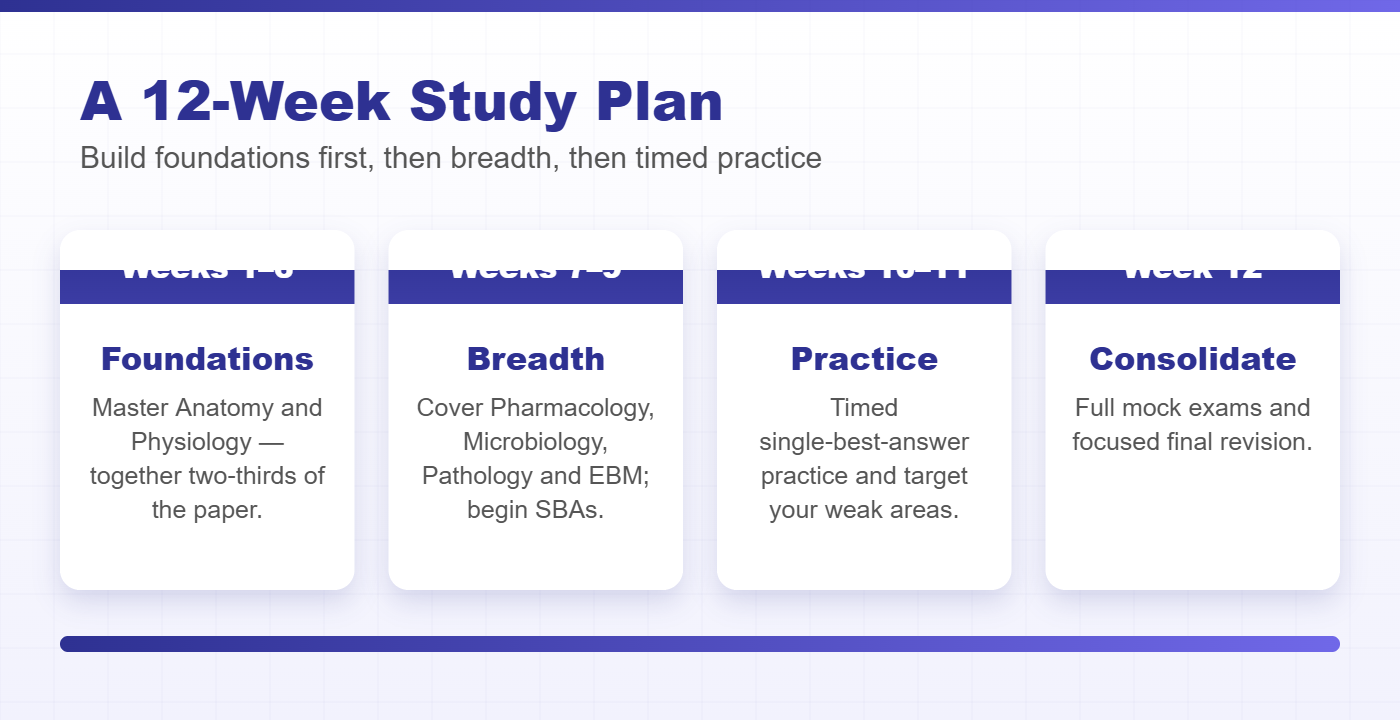
Map out the weeks you have before the exam and assign topics to each one, working backwards from your sitting date. Short, consistent daily sessions beat occasional marathon days every time, because the basic sciences reward spaced, repeated exposure. A sensible shape for a twelve-week run is to spend the first block building deep foundations in Anatomy and Physiology, the middle block adding breadth across the remaining subjects while you begin questions, and the final weeks on timed practice and revision rather than new material. Protect the last two to three weeks for consolidation — do not still be learning fresh topics the week before.
Make Questions the Core of Your Revision
Single-best-answer practice is the fastest way to learn how the exam actually thinks, so start questions early rather than saving them for the end. Treat every question as a mini-tutorial: read the explanation for the ones you get wrong, but also for the ones you got right by guessing, because those are hidden gaps. Keep a running list of the facts you keep forgetting and revisit it often. As the exam approaches, shift to full, timed blocks so you build the stamina and pacing you will need to answer 180 questions in three hours without rushing the last fifty.
Revise Actively, Not Passively
Re-reading notes feels productive but is one of the weakest ways to revise. Use active methods instead: spaced repetition for facts, one-line recall points you can test yourself on, quick self-quizzes, and — one of the most powerful techniques of all — explaining a topic out loud to a colleague. If you can teach it clearly, you know it; if you stumble, you have just found a gap to close. Diagrams you draw yourself for anatomy and physiology stick far better than diagrams you only look at.
Subject-by-Subject Tactics
For Anatomy, focus on the high-yield regions that recur — limbs, thorax, cranial nerves and the structures behind common procedures. For Physiology, make sure you can reason through cardiovascular, respiratory and renal mechanisms rather than just memorising values. For Pharmacology, understand drug classes, mechanisms and the agents used in emergencies. For Microbiology, know the common pathogens and antimicrobial principles. For Pathology, concentrate on mechanisms of disease, and for Evidence-Based Medicine, drill the core study designs and statistics, because these are reliable, learnable marks.
The Week Before and Exam Day
In the final week, revise your weak areas and your recall list, do a light amount of practice to stay sharp, and then rest — a tired brain underperforms. On the day, remember there is no negative marking, so never leave a question blank: make your best choice and move on. Watch your pace, flag anything you are unsure of to revisit, and trust the preparation you have put in.
Common Mistakes to Avoid
A handful of errors sink more candidates than any difficult topic. Studying every subject equally instead of following the blueprint wastes your most valuable hours. Hoarding questions for the final fortnight means you never learn from your mistakes in time to fix them. Passive re-reading creates a false sense of security that collapses under exam pressure. And starting fresh topics in the last week leaves you anxious and thinly spread. Name these traps early and you will sidestep them without much effort.
Choosing Your Resources
You do not need a shelf of textbooks. You need one reliable, blueprint-mapped set of notes, one good question bank, and at least a couple of full mock exams under timed conditions. More important than the exact resources is that they are current — mapped to the syllabus that applies to your sitting — and that you actually work through them actively rather than collecting them. Depth and consistency beat breadth and novelty every time in this exam.
Trust the Process
Finally, give the method time to work. Basic sciences reward repetition, and a fact that feels impossible in week two is often second nature by week eight simply because you keep meeting it. Resist the urge to judge your progress day to day; judge it across weeks. Keep your question scores in perspective — early practice is for learning, not for your ego — and expect your accuracy to climb steadily as exam day approaches. Candidates who stay consistent, follow the blueprint and keep practising almost always get there. The exam is designed to be passed by prepared, methodical people, and that is exactly what this strategy is built to make you.
How MRCEM Masters Helps
Consistency is what passes this exam, and that is exactly what a structured course is built to give you. Our MRCEM Primary course follows the official RCEM blueprint, with recorded sessions you can revisit anytime, high-yield PDF notes, and exam-condition mock tests — so you stay on schedule and walk into the exam knowing precisely what to expect. If you want a ready-made plan that mirrors the strategy above, that is what we have built. Reach out on WhatsApp if you would like help tailoring it to your exam date.
Official RCEM source: the MRCEM Primary syllabus, blueprint and regulations are published on the official RCEM website. From 21 April 2027 the updated Basic Sciences Syllabus applies.